

Table of Contents
The Blueprint Blunder Most Homeowners Make
What is the Critical Root Zone(CRZ)?
It’s Not Just About tree Cutting, It’s About Crushing<
How an Arborist helps
The New York Permit Minefield
When Removal is Actually the Right Choice
Post-Construction Therapy
The Verdict: Protect Your Investment
The Blueprint Blunder Most Homeowners Make
You’ve got the architect’s sketches, the contractor is lined up, and you’re dreaming about that new master suite or expanded kitchen. You’ve thought about the plumbing, the foundation, and the paint colors. But there is a massive, living asset on your property that you’ve likely overlooked and ignoring it could cost you thousands in fines, property damage, or the loss of a beloved landscape feature.
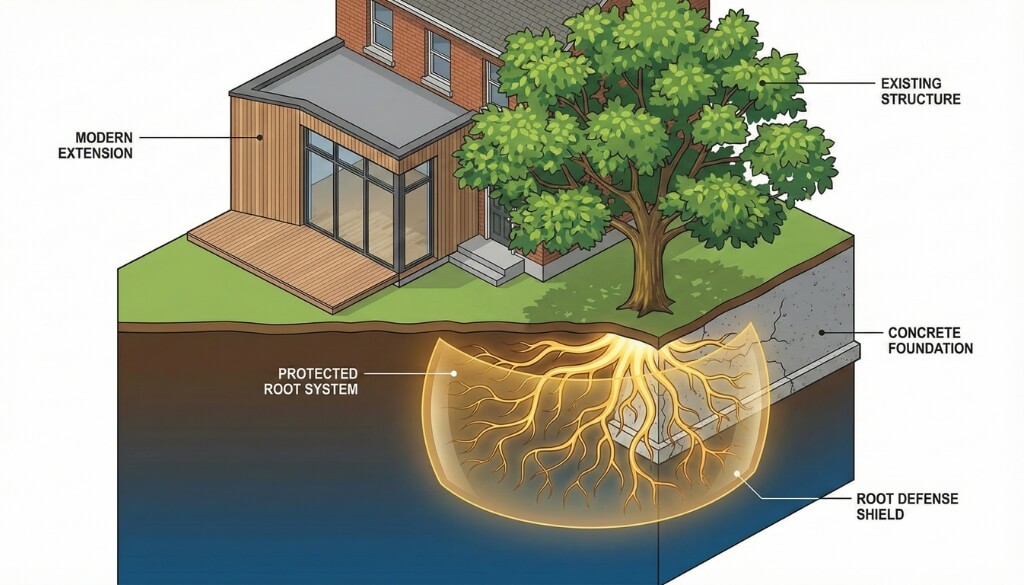
I’m talking about your trees.
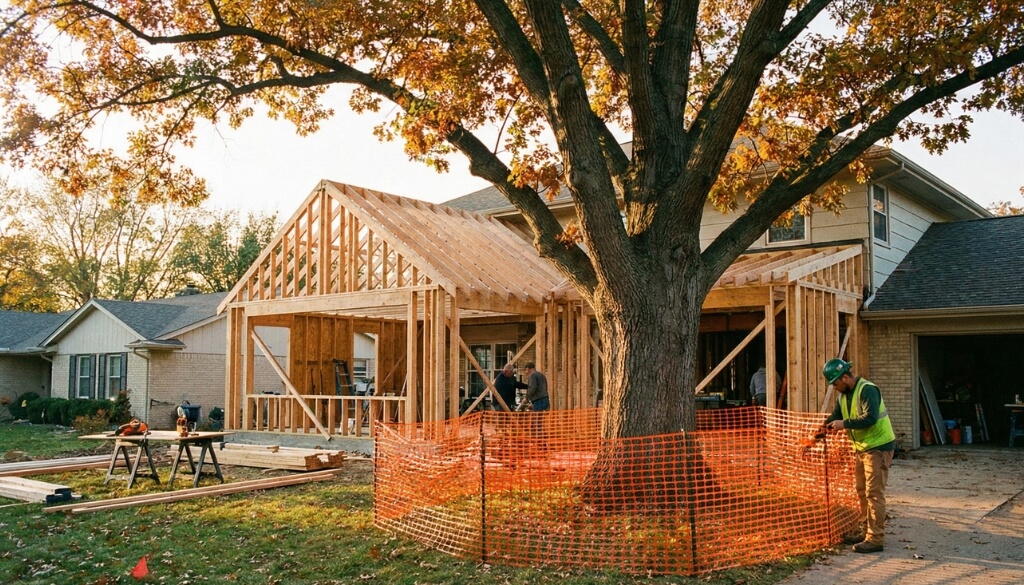
Most homeowners assume that as long as they don’t physically chop a tree down, it’s safe. This is a dangerous misconception. Construction is traumatic for trees. From severed roots to suffocated soil, the damage often happens underground, silently killing the tree over the next 3 to 5 years. By the time you notice the dieback, your warranty with the builder is long gone, and you’re left with a hazardous, dead giant looming over your brand-new addition.
Here is why bringing in a certified arborist during the planning phase not the building phase is the smartest investment you can make.
What is the Critical Root Zone(CRZ)?
If you look at a tree, you’re only seeing half the story. The root system is arguably more important than the canopy, and it extends much further than most people realize.
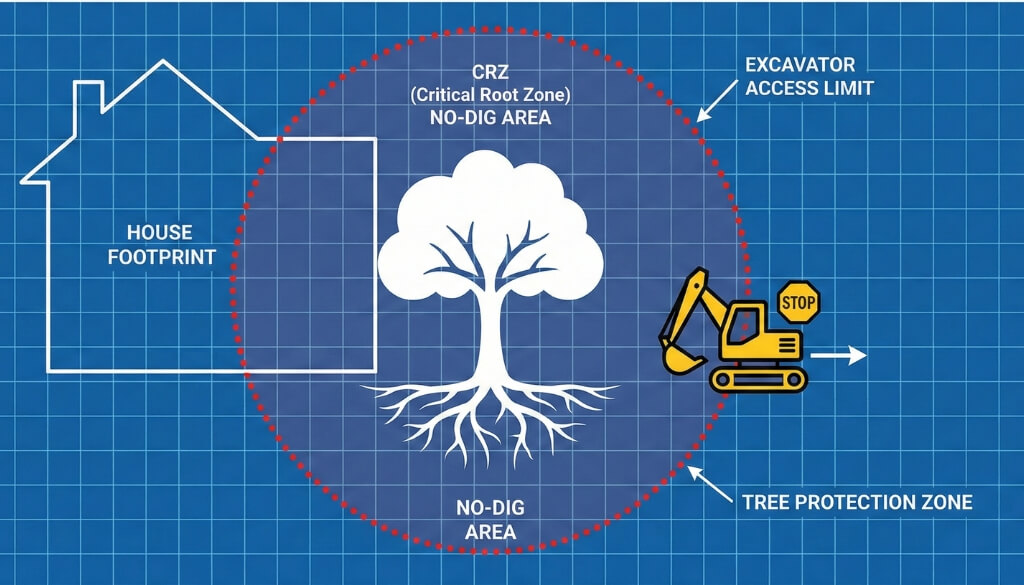
In the arboriculture world, we talk about the Critical Root Zone (CRZ). A general rule of thumb is that for every inch of trunk diameter (measured at chest height), you need about one foot of protected radius.
- Example: A 20-inch wide Maple tree needs a protective circle with a 20-foot radius.
If your new foundation cuts into this zone, you aren’t just “trimming roots.” You are likely severing the structural anchors that keep the tree from toppling over in a windstorm.
Furthermore, removing too many feeder roots deprives the tree of water and nutrients. We can often help you modify your construction footprint slightly or recommend to determine if the tree can survive the intrusion. It is far cheaper to adjust a blueprint now than to remove a dead, dangerous tree that is leaning over your new glass sunroom later.
It’s Not Just About tree Cutting, It’s About Crushing
Let’s say your addition is technically outside the Critical Root Zone. You’re safe, right? Not necessarily.
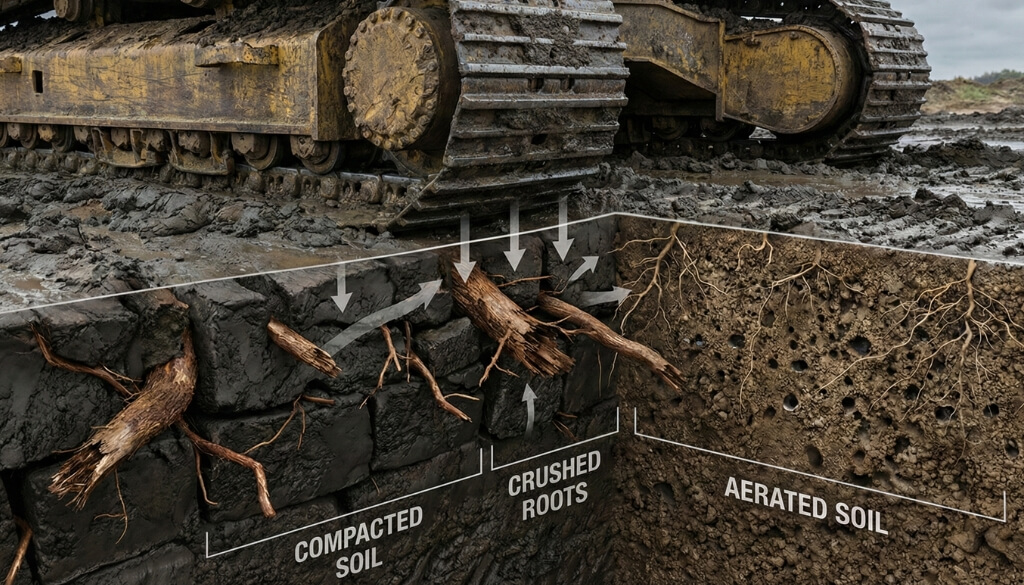
Construction involves heavy machinery excavators, dump trucks, and cement mixers. When this equipment drives over the soil around your trees, it causes soil compaction.
Healthy soil is full of air pockets that allow roots to breathe and absorb water. Heavy machinery crushes these pockets, turning the soil into a concrete-like substance. The roots suffocate, and the tree enters a slow decline.
How an Arborist helps here:
- Access Routes: We plan specific paths for machinery to minimize damage.
- Matting: We can recommend putting down thick ply-boards or AlturnaMATS to disperse the weight of the equipment.
- Protective Fencing: We don’t just wrap a ribbon around the trunk; we install sturdy fencing at the CRZ perimeter to physically stop contractors from parking their trucks on the root system.
The New York Permit Minefield
If you live in Brooklyn, Queen, or anywhere else in NYC, you already know that local building departments love paperwork. What you might not know is that many towns have strict “Tree Preservation Orders.”
If your construction plans involve removing a tree or even if your construction merely threatens a protected tree you often need a specific permit before a building permit is issued.
I have seen projects shut down instantly by a municipal inspector because a homeowner didn’t file the right tree paperwork. A “Stop Work Order” costs you time and money while the crew sits idle.
We specialize in navigating these bureaucratic waters. Our Tree Permit Services ensure that your project is compliant with local village codes, preventing nasty legal surprises.
When Removal is Actually the Right Choice
Sometimes, I’m the one who has to play the villain but I do it to save you money in the long run.
If a large tree is too close to the proposed structure, the cost of trying to save it (specialized root pruning, air-spading, fertilization) might outweigh the likelihood of its survival. If a tree has a 20% chance of survival after construction, it makes more sense to remove it before the house is built.
Why?
- Cost: It is infinitely cheaper and easier to perform Tree Removal on an empty lot than it is to crane-lift a dead tree over a brand-new, fragile roof two years later.
- Safety: A tree with comprised roots is a liability. You do not want to compromise the integrity of your new foundation.
Whether you are in Westchester or Long Island, we can give you an honest “Stay or Go” assessment.
Post-Construction Therapy
If we decide the tree can stay, the work isn’t done when the contractors leave. Your tree has just been through a major surgery. It needs aftercare.
Construction changes the water table and soil composition. We often recommend a regimen of:
- Vertical Mulching: Drills holes into the soil to re-introduce air.
- Deep Root Fertilization: Injecting nutrients directly where the roots need them.
- Corrective Pruning: Removing any canopy weight that the compromised root system can no longer support.
The Verdict: Protect Your Investment
Your home addition is an investment in your future. Don’t let a construction oversight turn your beautiful landscape into a liability. A consultation with an arborist is a fraction of the cost of your renovation, but it provides insurance against property damage, fines, and the loss of your property’s natural beauty.
Don’t wait until the excavator is in the driveway. If you are looking at blueprints, you should be looking for us.
Ready to start your project on the right foot? Contact GreenLeaf Tree Removal NY today for a pre-construction site assessment. Let’s make sure your dream home includes dream trees.

Written by