

Table of Contents
The Hardest Decision a Homeowner Has to Make
Sign #1: The “Silent Killer” at the Base (Fungal Fruiting Bodies)
Sign #2: Structural Defects (The Lean, The Crack, and The Hollow)
Sign #3: Crown Dieback (The “Top-Down” Death)
The Verdict: Don’t Wait for the Next Storm
The Hardest Decision a Homeowner Has to Make
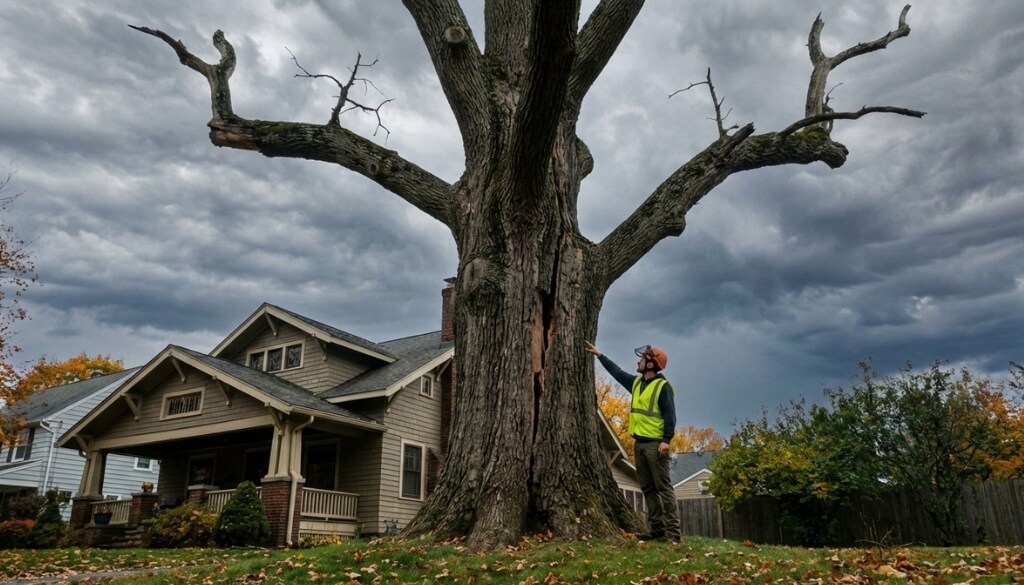
I’ve stood in hundreds of backyards across Long Island and Westchester, looking up at a towering Oak or Maple with a homeowner standing nervously beside me. There is almost always a sense of guilt. We love our trees. They provide shade, memories, and curb appeal. The idea of cutting one down feels like admitting defeat.
But here is the reality I often have to share: A tree has a lifespan, and holding onto a hazardous tree past its prime isn’t preservation, it’s a gamble with your home’s safety.
Living in New York, we know the damage a Nor’easter or heavy snowstorm can do. When a 5-ton tree fails, it doesn’t give you a two-week notice. However, trees do leave subtle clues before they fail. You just need to know how to read the language of decay.
If you are debating whether to call a professional, look for these three undeniable signs that it’s time to say goodbye.
Sign #1: The “Silent Killer” at the Base (Fungal Fruiting Bodies)
Most people look up to check a tree’s health. I look down.
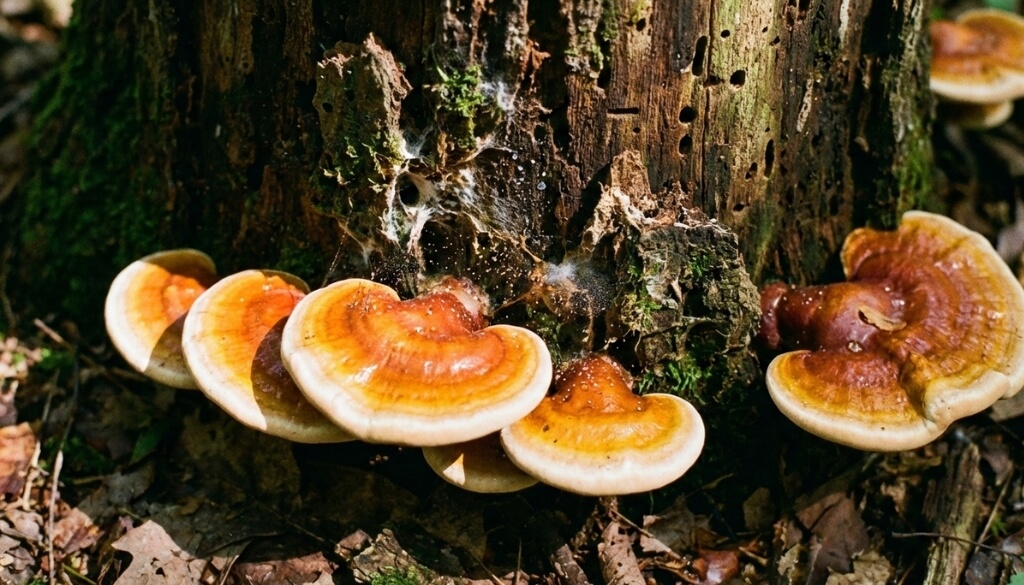
The most dangerous issues usually start in the root system or at the “root flare” (where the trunk meets the soil). If you see mushrooms or conks growing directly on the trunk or clustering at the base of the tree, this is a red alert.
In our region, we often see Ganoderma, a type of fungus that feeds on the structural wood of the tree. Unlike surface mold, these mushrooms indicate that the tree is rotting from the inside out.
Why this is a dealbreaker:
- Compromised Anchorage: The roots act as the anchor. If they are rotting, the tree can look perfectly green and healthy in the canopy but topple over completely in a moderate windstorm because nothing is holding it in the ground.
- The Severity: Once you see the “fruit” (the mushroom) on the outside, the infection on the inside is usually extensive and irreversible.
If you spot this, do not wait. Check our guide on identifying large and dangerous trees and call us immediately.
Sign #2: Structural Defects (The Lean, The Crack, and The Hollow)
Trees are engineering marvels, but they have breaking points. While a tree can survive a hollow cavity, there is a mathematical limit to safety.
The “1/3rd Rule” In arboriculture, we generally say that if a tree has lost more than 1/3rd of its structural wood (making it hollow), it is a high-risk candidate for failure. If you knock on the trunk and it sounds like a drum, or if you can see clear through a cavity, the structural integrity is gone.
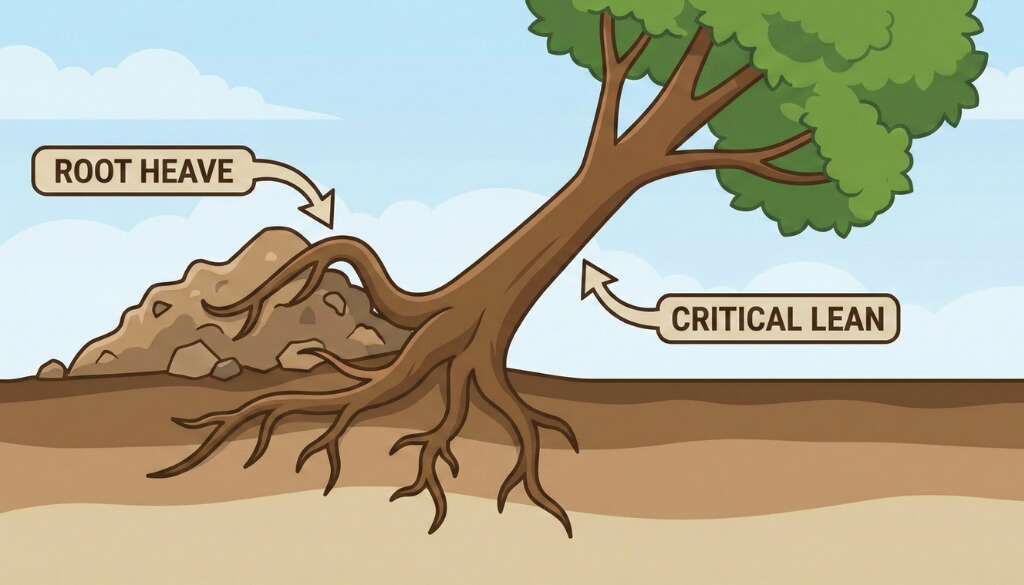
The Sudden Lean Trees rarely grow perfectly straight. A gradual lean that has developed over 40 years is usually fine; the tree has built “reaction wood” to support itself.
- The Danger Signal: A new lean. If your tree was vertical last year and is listing 15 degrees today, the roots have likely heaved. Look for mounded soil on the side opposite the lean, this means the roots are physically pulling out of the ground.
Deep Cracks A crack that extends deep into the wood or runs down opposite sides of the trunk is a sign that the tree is literally splitting apart under its own weight. This is common in trees that have been damaged by ice and snow.
According to the USDA Forest Service, a crack that goes through the bark and into the wood indicates a high potential for failure. You can read more about their Tree Risk Assessment guidelines here.
Sign #3: Crown Dieback (The “Top-Down” Death)
When a tree is stressed whether from drought, compacted soil, or root damage it goes into survival mode. It stops sending energy to the furthest points (the top branches) to conserve resources for the trunk.
This results in Crown Dieback.
What to look for:
- Stagheading: This is when the upper branches are bare and look like deer antlers sticking out of a green canopy.
- The Twig Test: If you can reach a lower branch, try to snap a small twig.
- Green and pliable? It’s alive.
- Brown and brittle (snaps easily)? It’s dead.
- Leaf Scarcity: If the tree leafs out late in spring or drops leaves way too early in August, it is struggling.
While some dieback can be treated with pruning or deep root fertilization, extensive dieback (over 40-50% of the canopy) usually means the tree has lost the ability to photosynthesize enough energy to recover. At that point, it becomes a falling hazard targeting your roof or driveway.
If you are unsure if your tree is just sick or actually dying, you can reference our guide on how to spot a dying tree.
The “Target” Factor: Context Matters
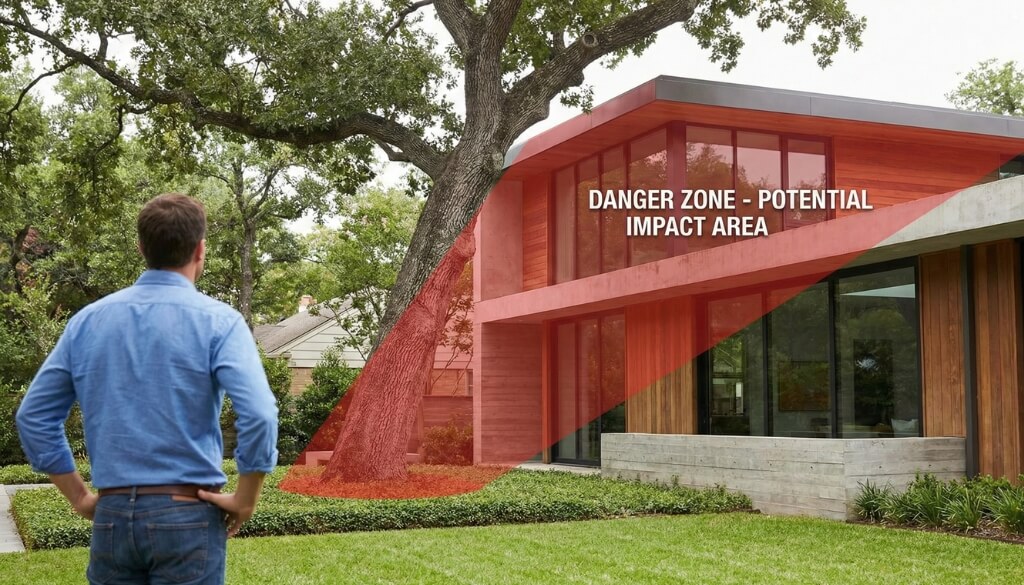
Here is the final piece of the puzzle that often surprises homeowners. A dead tree deep in the woods behind your property is “habitat.” A dead tree next to your master bedroom is a “hazard.”
We perform a Tree Risk Assessment based on the “target.” If the tree falls, what will it hit ?
- Your house?
- Power lines?
- Your neighbor’s fence? (See our guide on liability for tree damage).
If the target is high-value, your tolerance for risk should be zero.
The Verdict: Don’t Wait for the Next Storm
Removing a tree is a significant decision, but protecting your family and property is the priority. If your tree is showing fungal growth, structural cracks, or significant dieback, the question isn’t if it will fall, but when.
It is far better to schedule a controlled Tree Removal on a calm Tuesday than to need Emergency Tree Service at 3:00 AM during a hurricane.
Unsure about the health of your trees? Don’t guess. Contact GreenLeaf Tree Removal NY today for a professional consultation. We serve Nassau, Suffolk, Westchester, and the five boroughs. Let us give you the honest answer your property needs.

Written by