

Does the string of landscape lights along your front walk, or the security floodlight over the driveway, actually change how a tree behaves? For a lot of homeowners planning a landscaping refresh, outdoor lighting and trees rarely get considered together, yet trees read light on a schedule that goes back millions of years, and a bulb left on all night is information the tree was never built to ignore.
This is not a call to rip out every path light. It is a look at what artificial light actually does to a tree’s internal calendar, which fixtures matter most, and where the real evidence stops and speculation begins, so you can make a reasonable decision about your own yard instead of guessing.
How a tree tells day from night in the first place
Trees do not have eyes, but they have something close to a sense of them: light sensitive pigments in their leaves that track the length of daylight and darkness across the seasons. That tracking, called photoperiodism, is how a tree in Queens knows to stop putting energy into new growth in September and start hardening its tissue for winter, well before the first frost arrives. The signal is not the temperature. It is the length of uninterrupted darkness the tree experiences each night.
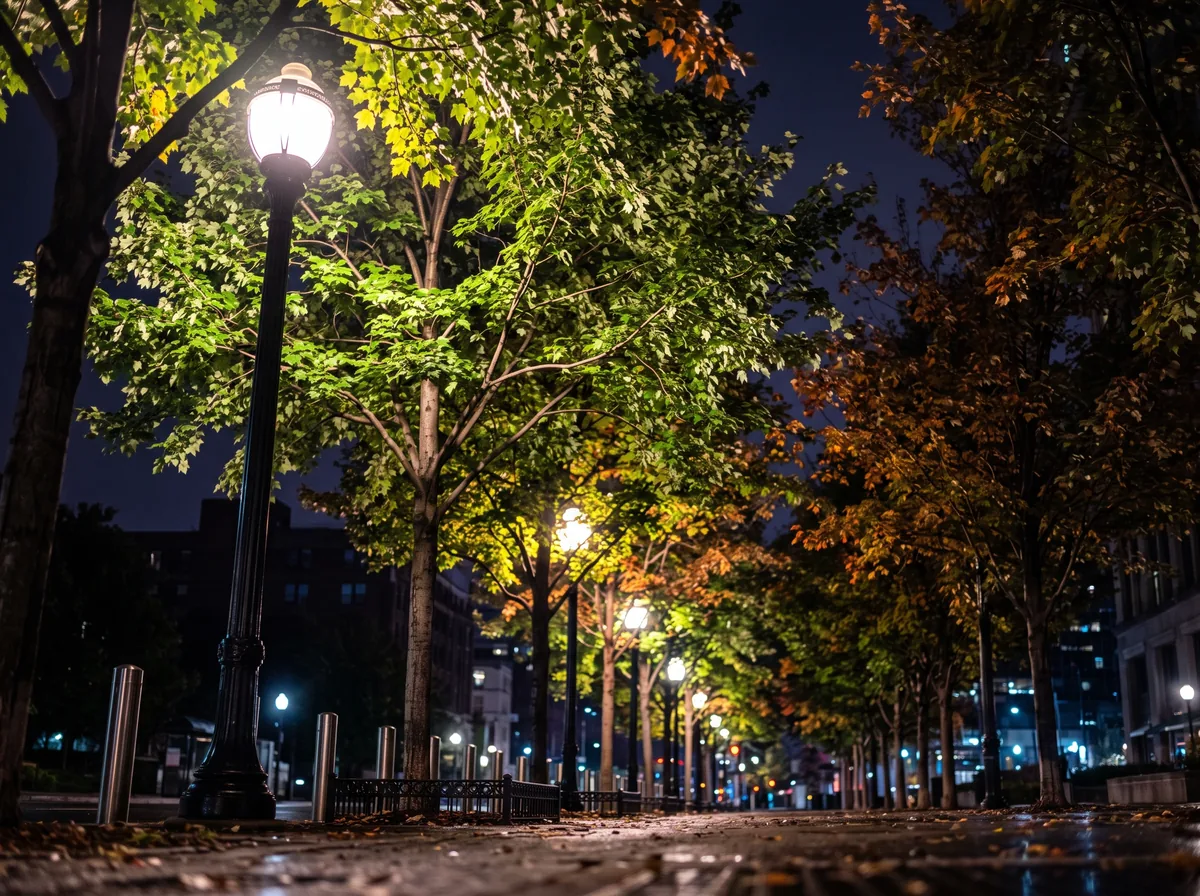
Streetlights, floodlights, and even a bright porch fixture left on until sunrise can interrupt that darkness. The tree does not distinguish a security light from the sun. It only registers photons hitting its leaves, and enough of them, at the wrong time of year, can blur the seasonal signal the tree depends on.
Did you know
Some deciduous trees near especially bright streetlights hold their leaves noticeably later into the fall than the same species growing just a block away in darker conditions. Researchers have documented this pattern in city trees for decades, though how much it affects any single tree’s long term health still depends on the species and the intensity involved.
What outdoor lighting and trees actually have in common
The relationship between outdoor lighting and trees comes down to timing more than brightness alone. A tree exposed to light late into a summer night is not usually harmed by that single event. It is repeated, season spanning exposure, especially through the shortening days of early fall, that has the most potential to matter, because that is exactly the window when a tree is reading darkness length to start preparing for winter.
The USDA Forest Service’s urban forestry program catalogs light at night as one of several environmental stressors that city trees deal with alongside heat, compacted soil, and road salt. None of these factors act alone, and a young or already stressed tree generally has less capacity to absorb an added disruption than a mature, well established one.
People often ask
Is a single security light really going to hurt my tree? Almost certainly not on its own. The pattern researchers describe involves sustained, nightly exposure over multiple seasons, not a motion sensor light that trips a few times a week. Context and duration matter far more than any one fixture.
Which fixtures matter most
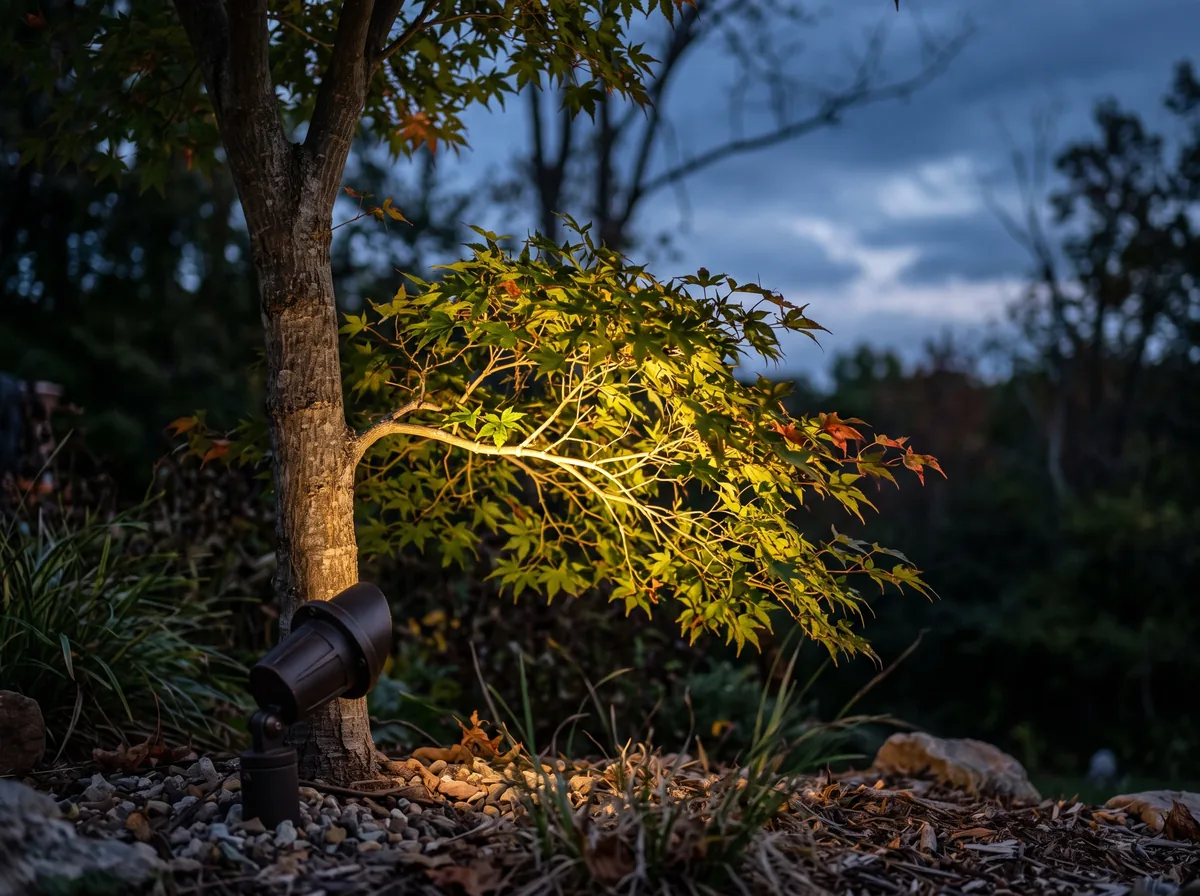
Not every fixture pairing of outdoor lighting and trees carries the same weight. A dim, downward facing path light rarely reaches a tree’s canopy at all. The fixtures worth thinking about are the ones that shine upward or sideways into branches for hours at a stretch: uplighting aimed directly into a canopy, a floodlight mounted high on the house, or a nearby streetlight positioned close to a young tree’s crown.
- Uplights aimed into a canopy, especially left on from dusk to dawn rather than on a timer or motion sensor.
- Floodlights or security lights mounted at a height that illuminates branches rather than just the ground below.
- A streetlight or parking area light positioned close enough that a young tree’s crown sits within its direct glow.
- Continuous, unshaded light sources left on through the shorter days of early fall, when a tree is most actively reading darkness length.
What the evidence does and does not show
Researchers studying urban trees near bright light sources have generally found delayed fall leaf drop and, in some cases, later spring budbreak in the most exposed individuals, which fits the photoperiod explanation. What the research has not settled is exactly how much lasting stress this adds for a given species, since trees also vary a great deal in how sensitive they are to light at night in the first place. Some species barely respond. Others noticeably do.
That gap between an observed pattern and a settled conclusion about every tree’s long term outcome is worth sitting with rather than filling in with a guess. If a mature tree on your property has been sitting under a bright fixture for years and you have also noticed other changes worth a closer look, the general signs of a tree in decline are a useful starting point, though a certified arborist should be the one connecting any dots between lighting and a specific tree’s condition.
Good to know
The relationship between outdoor lighting and trees described here reflects general patterns observed in research on urban trees, not a diagnosis of any specific tree on your property. How much a given light source matters depends on the species, the fixture, and years of exposure together. Have a certified arborist evaluate a tree you are concerned about rather than relying on this article alone.
Practical choices for your own yard
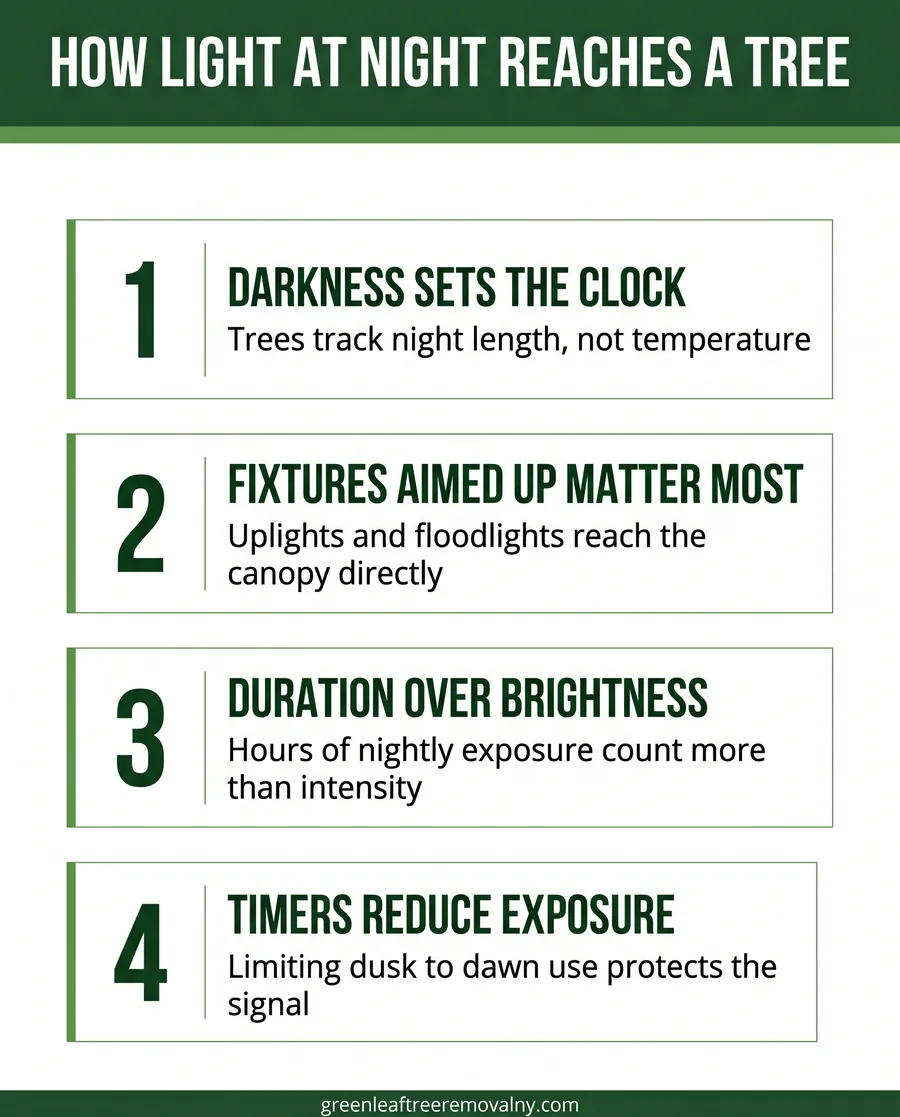
None of this means giving up on landscape lighting altogether. A few adjustments cover most of the concern: put uplights and floodlights on timers so they are not running from dusk to dawn, aim fixtures at the trunk or a facade rather than directly into a canopy, and choose warmer color temperature bulbs, which several studies on nighttime light and plant response have associated with a gentler effect than harsher blue toned lighting.
For a newly planted or young tree especially, keeping it well outside the direct throw of any fixture for its first several years gives it the best chance to establish a normal seasonal rhythm before it has to compete with anything else. If you are planning new plantings alongside a lighting project, our guide to planting a tree in the city covers placement considerations worth weighing at the same time as fixture layout. If a mature tree in Brooklyn already sits close to strong fixtures and shows other changes at the same time, a full canopy evaluation in Brooklyn is a more useful next step than adjusting the lighting alone.
Download the free quick guide
A printable guide to fixture placement, timers, and what to ask a lighting installer if you have mature trees nearby.
Frequently asked questions
Do all tree species respond the same way to outdoor lighting at night?
No. Sensitivity to nighttime light varies a lot by species, and some trees show almost no visible response even under fairly bright, sustained exposure. Others, particularly some deciduous species, are more likely to show delayed fall color change or later leaf drop when they sit close to a strong, unshaded light source for years. If you are choosing trees for a spot near existing lighting, that variability is worth asking about before you plant.
Is solar landscape lighting less of a concern than wired fixtures?
Not necessarily, since what matters most to a tree is the timing and duration of the light it receives, not the power source behind it. A solar fixture that stays lit from dusk until its battery runs out partway through the night behaves the same way to a nearby tree as a wired light on the same schedule. Where solar fixtures often help is that many are dimmer and lower to the ground, which reduces how much light actually reaches the canopy above.
Should I remove a floodlight near a tree that seems to be struggling?
That depends on what else is going on with the tree, which is why a light source alone is rarely the whole story. If the tree is showing other signs worth a closer look, have a certified arborist assess it in full before assuming the light is the cause or making any changes. Removing or repositioning a fixture is a reasonable precaution either way, but it should follow an actual look at the tree, not replace one.
Does this apply to street trees near public lighting too?
Yes, and it is one reason some city trees near tall streetlights hold their leaves later into fall than trees on darker blocks nearby. Homeowners generally cannot change public streetlight placement, but understanding the pattern helps explain why a street tree in front of your house might look and behave slightly differently than a similar tree in a backyard further from direct light.
What is the single easiest change to reduce the effect on my trees?
Putting outdoor lights on a timer or a motion sensor rather than leaving them on continuously from dusk to dawn addresses most of the concern with the least effort. That single change limits both the duration and the total hours of exposure a nearby tree gets each night, which is the factor most closely tied to the seasonal confusion researchers describe.
If you are weighing a lighting plan against a mature tree’s canopy, or you have noticed a tree near a bright fixture acting differently than its neighbors, book a visit from our arborists and we will look at the tree and the lighting together.